Breaking the Cooling Barrier: How Distributed CDU Liquid Cooling Pumps Unlock Next-Generation Data Center Thermal Performance
Compute Growth Meets Thermal Limits
AI model training, high-performance computing (HPC), and large-scale inference workloads are driving unprecedented increases in rack power density. Next-generation accelerators—such as the NVIDIA GB200 and AMD MI300—push single-chip TDP levels beyond 700W, with full racks often exceeding 20–30 kW. Traditional air-cooling, limited to roughly 8 kW per rack, can no longer keep pace.
The global liquid-cooling market is projected to reach USD 2.84 billion in 2024, with cold-plate liquid cooling leading growth at over 62% CAGR. As the industry shifts toward liquid cooling, the CDU (Coolant Distribution Unit) pump is evolving from a supporting component into a critical enabler of system performance, energy efficiency, and reliability.
1. What Is a CDU?
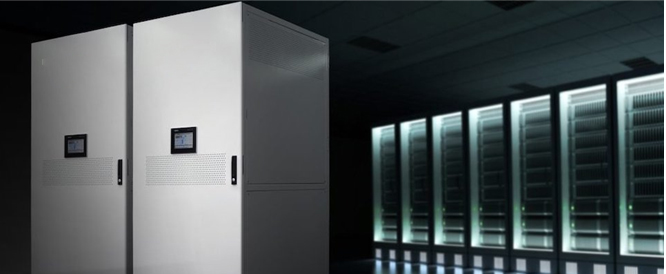
A Coolant Distribution Unit (CDU) is the central heat-exchange module of a data-center liquid-cooling system. It circulates coolant through cold plates to capture chip-level heat, then transfers that heat to the facility’s primary cooling loop.
In essence, a CDU functions as a precision thermal transport engine:
Coolant absorbs heat from CPUs/GPUs and returns to the CDU at elevated temperature.
The CDU’s heat exchanger transfers this heat to the facility water loop.
The CDU liquid cooling pump recirculates the cooled fluid back to the servers, maintaining a continuous, high-efficiency cooling cycle.
Pump performance determines flow stability, cooling capacity, and system reliability—making it the true heart of the CDU.
2. Centralized vs. Distributed CDU Architectures
| Feature | Centralized CDU | Distributed CDU |
|---|---|---|
| Architecture | Large units located at room or aisle endpoints; long, complex piping | Modular units placed near racks; short, efficient piping |
| Initial Investment | High; extensive mechanical work required | Lower; scalable and incremental |
| Scalability | Limited; requires upfront peak-capacity planning | Excellent; add modules as workloads grow |
| Energy Efficiency | High at full load but less efficient at partial load; high transport losses | Higher real-world efficiency; minimal transport loss |
| Reliability | Single-point-of-failure risks | Strong fault isolation; only a few racks affected |
| O&M | Maintenance affects large areas | Localized maintenance; minimal downtime |
| Flexibility | Poor for retrofits or mixed-density deployments | Ideal for phased build-outs and legacy upgrades |
| Pump Requirements | High flow, high head, large pumps | Low head, compact, high-efficiency pumps |
| Cooling Power | High and fixed consumption | Low, elastic, load-proportional consumption |
3. Flow-Rate Challenges in Distributed Architectures
3.1 Precision Matching of Flow and Thermal Load
| Rack Cooling Load | Required Min. Flow | Limitations of Traditional Pumps |
|---|---|---|
| 8–15 kW | 30–50 L/min | Flow fluctuation > ±15% |
| 15–20 kW | 70–100 L/min | Efficiency loss > 25% |
| 30 kW+ | 100–130 L/min | Sharp drop in reliability |
3.2 Industry Pain Points
Limited lifespan (≈15,000 hours), leading to >6% annual failure rates
High energy consumption: pumps account for 35%+ of cooling system power
Lack of intelligence: unable to adapt to dynamic heat loads
High noise levels (>80 dB), restricting deployment scenarios
4. TOPSFLO’s Breakthrough: High-Performance Brushless Pumps for Distributed CDUs
4.1 30,000-Hour Extended Lifetime
Reduces lifecycle operating expense and improves system availability.
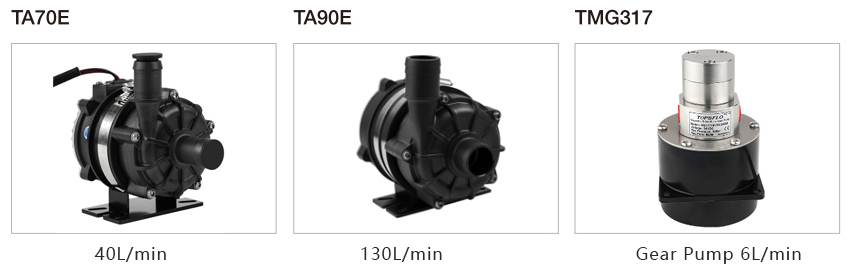
4.2 Intelligent 30–130 L/min Wide-Range Flow Control
Optimizes cooling for diverse rack power profiles.
4.3 Ultra-Low Noise Operation (≤60 dB)
Enables deployment near office areas and mixed-use facilities.
4.4 Higher Space Efficiency
Supports compact CDU modules, improving usable floor space by up to 30%.
4.5 Zero-Leakage Structural Design
Enhances system safety and long-term reliability.
4.6 Up to 50% Improvement in Heat-Transfer Efficiency
Achieved through refined hydraulic design and precise flow regulation.
4.7 Full Application Coverage
30–50 L/min: edge servers
50–100 L/min: AI training nodes
100–130 L/min: HPC and supercomputing racks
Control Precision:
Flow stability: < ±2%
Temperature differential control: < 0.5°C
4.8 Delivery Lead Times Reduced from 12 Weeks to 4 Weeks
Stronger supply-chain resilience for rapid deployment.
4.9 Faster Customization (70% Improvement)
Better alignment with regional and application-specific requirements.
Conclusion: Enabling the Next Era of Liquid-Cooled Compute Infrastructure
As compute density continues to double every 24 months, cooling has become a determining factor—not merely a supporting function—in data-center performance and efficiency. We invite data-center operators, server OEMs, and system integrators to evaluate this next-generation pump platform and explore new possibilities for high-efficiency, high-reliability liquid-cooling deployments.
Together, we can accelerate the transition to a sustainable, high-performance, liquid-cooled future.


